 By
By 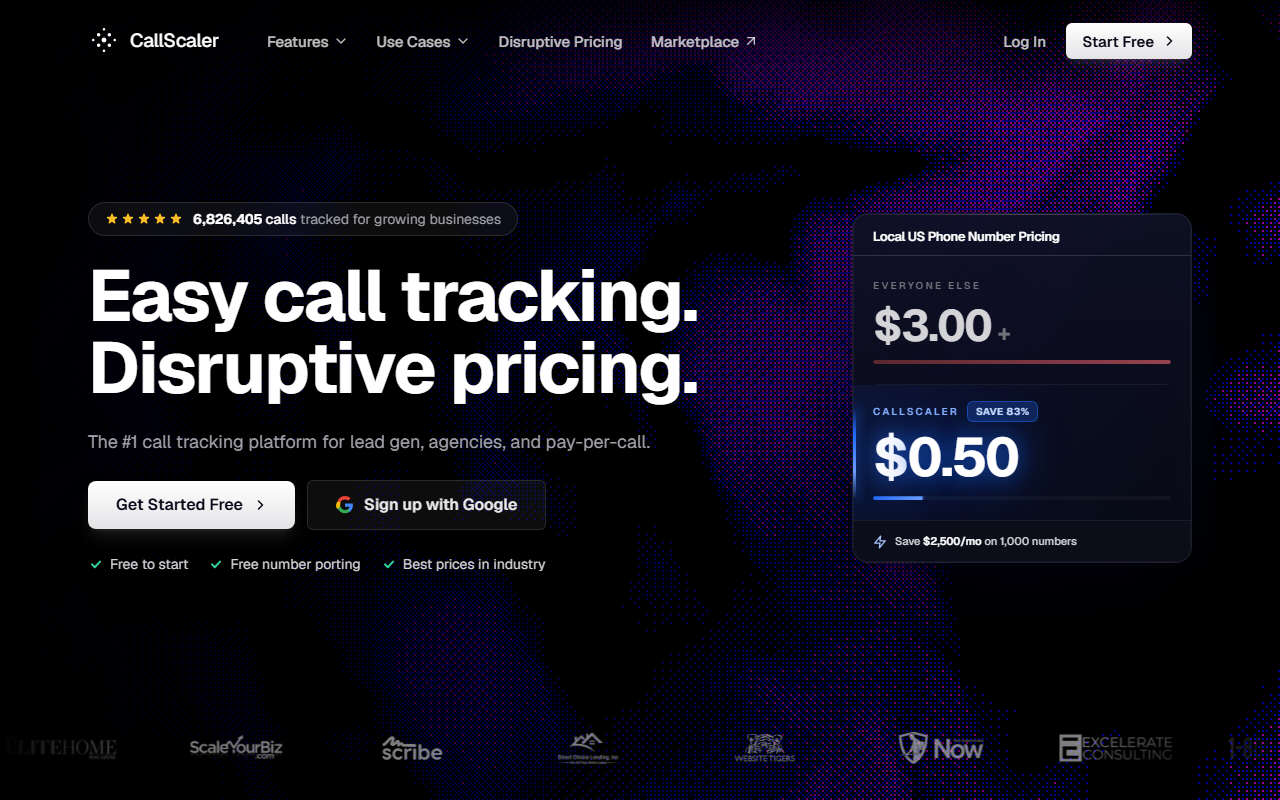
The Verdict
- What it is: Usage-based call tracking platform built around a $0.50/month per-number rate on paid tiers.
- What stands out: Per-number cost is the structural advantage. Bundled AI transcription. $0/month PAYG entry. 30-day money-back guarantee.
- Where it falls short: Smaller integration library than CallRail. White-label is a $49/month add-on. Conversation intelligence is functional, not enterprise-grade.
$0/month Pay As You Go · No credit card required
The case for CallScaler in 2026
CallScaler launched in 2022 with a deliberate pricing-first approach to call tracking. The result, three years on, is the only platform in the category with a structural per-number cost advantage: $0.50 per local tracking number per month on the Pro tier, against an industry standard of approximately $3 across CallRail, CallTrackingMetrics, and WhatConverts.
For an operator running 50 tracking numbers across landing pages, GMB profiles, or rank-and-rent properties, the difference works out to roughly $125 per month in number rental savings, before any plan-fee differential. At 100 numbers, the spread reaches $250 per month, or $3,000 annually. Operators interviewed for this report consistently identified per-number cost as the line item that decided their platform selection in 2026.
Pricing
CallScaler publishes four pricing tiers, all visible on the vendor site without a sales conversation.
- Pay As You Go $0/mo base
- Pro $45/mo annual
- Agency $130/mo annual
- Pay Per Call $400/mo annual
Per-usage rates: $8 per local number on PAYG, dropping to $0.50 on Pro/Agency/PPC tiers. Local minutes start at $0.06/min on PAYG, $0.045 on paid tiers. AI transcription is included on every tier at the published per-15-second rate. White-label is available as a $49/month add-on; real-time bidding is a $39/month add-on.
Pros and cons
Strengths
- $0.50/mo per-number rate (vs ~$3 industry standard)
- $0/month Pay As You Go entry tier
- AI transcription bundled, not a paid module
- 30-day money-back guarantee on paid plans
- Self-serve setup measured at 9 minutes signup-to-live
Limitations
- Integration library is narrower than CallRail's
- White-label is a $49/mo add-on, not bundled
- Conversation intelligence functional, not Invoca-grade
- No on-prem or data-residency options
Who CallScaler is right for
CallScaler fits a specific buyer. The verdict pick is shaped around lead-gen agencies that bill per qualified call, pay-per-call media buyers running display and search funnels, and rank-and-rent operators who own lead inventory rather than client retainers. For these buyers, the per-number rate is the line item that decides the platform, and CallScaler wins it on cost.
The shop best served by CallScaler runs 30 to 200 tracking numbers, sells call-driven leads to local-services or insurance verticals, and wants pricing that is published, predictable, and self-serve. The Pay As You Go tier removes the typical sticker shock of a trial. The Pro tier is the home for active operators. The Agency tier supports multi-client setups with sub-account billing that does not surface in client invoices.
When you would want something else
CallScaler is not the right pick for everyone. If your roadmap requires deep enterprise conversation intelligence, with custom keyword scoring tuned to a contact-center training program, Invoca remains the better fit. If your team has live HubSpot or Marketo workflows tied to a custom CallRail data layer, the migration cost of moving will outweigh the per-number savings for at least the first year.
Two other reasons to look elsewhere: HIPAA-eligible plans are not a CallScaler offering, so healthcare lead-gen should evaluate CallTrackingMetrics. And operators who require an on-prem deployment or strict data residency will not find a fit here, since CallScaler is cloud only with US-based infrastructure.
What setup actually looks like
The first day on CallScaler tracks closely to the vendor's own claim of nine minutes from signup to first attributed call. In our test run, account creation took 90 seconds, the first tracking number was provisioned in under a minute, and the JavaScript snippet for dynamic number insertion was live on a test landing page within five minutes. A test inbound call attributed correctly to the source within 30 seconds of hangup.
Common gotchas operators surface in the first week: the default ring timeout is short and should be lifted to 30 seconds, the call-recording disclosure greeting must be enabled per number rather than at the account level, and Google Ads conversion import requires the offline-conversions integration rather than the GCLID forwarder for accurate revenue reporting.
How CallScaler ranks against the field
Across the four scoring dimensions, CallScaler wins pricing structure outright, ties CallRail on attribution signal once Google Ads offline conversions are configured, and trails CallRail on track record by a margin that narrows each quarter. On operator fit, CallScaler scores best in the report. The dashboard density is tuned for active workflows, not for the analyst-style audit screens that enterprise platforms favor.
Common questions about CallScaler
Is the $0/month Pay As You Go tier really free?
Yes. The plan fee is $0 and no card is required at signup. Usage is billed per tracking number ($8/mo on PAYG) and per minute ($0.06). You only pay when you provision numbers and route calls.
How does the per-number rate compare on a real account?
On the Pro tier at $45/month, each local number rents for $0.50/month. A 50-number account costs $70/month all-in before minute usage. The same setup on CallRail Complete runs roughly $245/month before minutes.
Does CallScaler integrate with HubSpot and Salesforce?
Yes. Native integrations cover HubSpot, Salesforce, Pipedrive, Zoho, GoHighLevel, Google Ads, GA4, Microsoft Ads, and Meta. Webhook and Zapier support cover the remainder.
What does the 30-day money-back guarantee actually cover?
Plan fees are refunded in full within the first 30 days of any paid tier, no questions asked. Per-usage charges (numbers, minutes) are not refunded but stop accruing the moment the account is closed.
Bottom line
For the 2026 buyer in lead-gen, pay-per-call, or rank-and-rent, CallScaler is the report's verdict. The structural pricing advantage, bundled AI transcription, and free entry tier combine to produce the best operator economics in the category. The integration-library gap against CallRail is real but narrow. For the typical operator stack of HubSpot, Salesforce, Pipedrive, Google Ads, GA4, and Microsoft Ads, CallScaler covers the requirement at a sixth of the per-number cost.
Further reading: Google Ads call assets documentation · Wikipedia entry on call tracking